
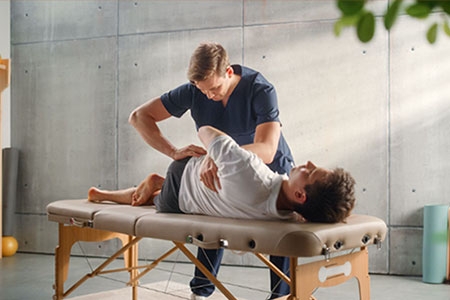
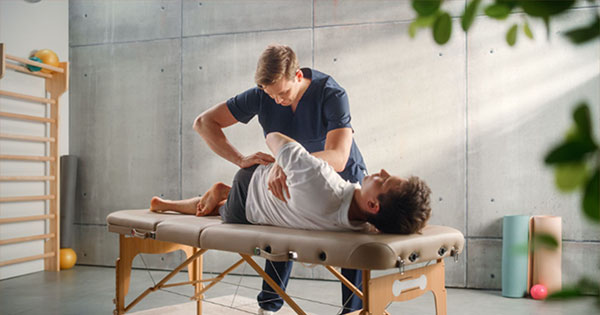
Every athlete knows the moment: a pop, a twist, a landing that goes wrong. Suddenly, the question is how serious it is and what it will take to get back. Physical therapy plays a major role in almost every sports injury, but its role depends on the injury. For minor injuries, it can be the whole treatment. For significant structural injuries like ACL and meniscus tears, it is an essential partner to surgery, not a substitute for it.
Where Physical Therapy Is the Right Treatment
Structured rehabilitation restores motion, rebuilds strength, and retrains the movement patterns that keep a joint stable. For many minor injuries, it is often all you need:
- Mild to moderate ligament sprains
- Muscle strains
- Tendinopathy and overuse injuries
- Patellofemoral (kneecap) pain
- Minor, stable joint injuries without structural tearing
For these, a committed rehabilitation program is usually the right first step. It gets athletes back to their sport without the risks and downtime of an operation they don’t need.
ACL Tears: Why Surgery Is Usually the Right Call
The anterior cruciate ligament does not heal on its own. It sits inside the joint, bathed in fluid that prevents the kind of self-healing seen in other tissues. A torn ACL leaves the knee less stable, and for active people, that instability matters. Each time the knee gives way, it can injure the meniscus and cartilage, damage that often cannot be reversed or repaired later.
For most active patients, especially those who pivot, cut, jump, or play contact sports, ACL reconstruction is the safer long-term path. In our experience, trying to manage an ACL tear without surgery carries more long-term risk than surgery does. A smaller group of patients, typically older and less active, may do fine without an operation and not be harmed by that choice. That decision should come after a thorough exam, not by default.
Meniscus Tears: Don’t Wait Until the Damage Is Permanent
The meniscus is the knee’s shock absorber, and only its outer edge has a good blood supply. Many tears have little capacity to heal without help. A torn meniscus that goes untreated can catch, lock, or fray further, and over time it can contribute to cartilage loss and arthritis that no treatment can undo.
For most active patients with a meniscus tear, timely surgical treatment protects the knee better than waiting. As with the ACL, older and less active patients with mild symptoms are the exception, and non-surgical care may be reasonable for them.
Physical Therapy Before and After Surgery
For ACL and meniscus injuries, PT is central to the outcome, just in a different role:
- Before surgery (prehab): Restoring motion, reducing swelling, and rebuilding strength before an operation leads to a smoother recovery.
- After surgery: Rehabilitation protects the repair, rebuilds strength and stability, and retrains movement patterns. It is also what safely guides an athlete back to sport.
The surgery fixes the structure, but the rehabilitation is what makes the body work again. Skipping or rushing it can undermine even a technically perfect repair.
Signs You Should Be Evaluated Promptly
See a specialist soon if you have:
- A pop at the time of injury, followed by swelling
- A knee that locks, catches, or won’t fully straighten
- A joint that gives way or feels unstable
- Significant weakness or pain that isn’t improving
An in-person exam and imaging come first, because the right treatment depends on an accurate diagnosis. Some tendon and joint problems may also be candidates for orthobiologic treatments such as PRP, which can sit between rehabilitation and surgery for selected patients.
Frequently Asked Questions
Can a meniscus tear heal without surgery?
Some tears might heal, particularly small ones in the well-supplied outer edge and older, less active patients may do well without surgery. But most tears do not heal on their own, and in active patients, waiting risks further damage to the meniscus and cartilage that is often irreversible.
Do you always need surgery for a torn ACL?
Not every patient, but most active ones do. The ACL does not heal on its own, and an unstable knee can injure other structures with each instability episode. Older, less active patients are the group most likely to do well without surgery.
Is physical therapy still important if I need surgery?
Absolutely. Prehab prepares the knee for surgery, and post-operative rehabilitation is what restores strength, stability, and confidence to return to sport.
When is physical therapy enough on its own?
For minor injuries such as mild sprains, strains, tendinopathy, and overuse problems, PT is often the primary treatment.
How do I know if my injury is minor or needs surgery?
You can’t reliably tell from symptoms alone. A pop, swelling, locking, or instability are warning signs, and an exam with imaging can confirm what’s going on.
The best treatment is the one matched to your injury, your sport, and your desired activity level. If a sports injury has you sidelined, you can request an appointment with Dr. DiGiulio and the team to talk through whether rehabilitation, surgery, or a combination is right for you.
AUTHOR: Milan M. DiGiulio, M.D. – Orthopaedic Surgeon, Sports Medicine & Arthroscopy Specialist
Milan M. DiGiulio, M.D. is a board-certified orthopaedic surgeon with subspecialty certification in sports medicine. He specializes in arthroscopic surgery of the shoulder and knee, including labrum repairs, rotator cuff tears, ACL reconstruction, and meniscus repair. Dr. DiGiulio also provides non-surgical options such as orthobiologic treatments using platelet-rich plasma (PRP) injections. He served as the Head Team Orthopaedic Surgeon for the North Carolina Courage professional women’s soccer team and is the founder of Performance Orthopaedic Surgery & Sports Medicine in 2009.
Credentials & Recognition
Dr. DiGiulio earned his undergraduate degree from the University of California, Los Angeles and his medical degree from Mt. Sinai School of Medicine in New York. He completed his orthopaedic surgery residency at Tufts University School of Medicine, serving as Chief Resident at Boston’s Floating Hospital for Children and New England Baptist Hospital. He was elected to the Alpha Omega Alpha Honor Medical Society and received the Oppenheimer Award for highest overall grade in his surgery rotation. Dr. DiGiulio has practiced as a Clinical Instructor in Orthopaedic Surgery at Tufts University School of Medicine. He is an active member of the American Orthopaedic Society for Sports Medicine and the Arthroscopy Association of North America.
Clinical Expertise
Dr. DiGiulio performs approximately 200 arthroscopic shoulder and knee procedures each year. His expertise includes minimally invasive arthroscopy, ACL reconstruction, meniscus repair, labral repair, rotator cuff surgery, and advanced non-surgical treatments such as PRP and orthobiologics. He emphasizes patient-centered care, precision surgical techniques, and comprehensive rehabilitation strategies to optimize outcomes for children, teens, and adults.
Medical Disclaimer: This information is for educational purposes only and does not constitute medical advice. For diagnosis and treatment recommendations, please consult with Dr. Milan M. DiGiulio or another qualified orthopaedic specialist.
Content authored by Milan M. DiGiulio, M.D., and verified against official sources.