
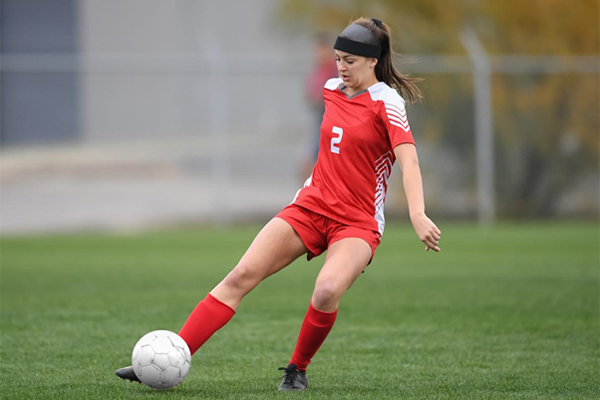
An ACL tear can happen in a split second: a landing, a sudden change of direction, or a pivot that sends the knee into an unexpected position. But the reasons some athletes face a higher risk are much more complex than a single movement. Research has identified differences in anatomy, biomechanics, neuromuscular control, and other factors that may contribute to ACL injury risk in female athletes. Understanding those factors may also help shape prevention strategies.
The Anatomy Behind the Numbers
Part of the answer lies in basic anatomy. Women generally have a wider pelvis relative to their height, which creates a greater angle at the knee, often called the Q-angle, between the hip and the shin bone. This altered alignment can place extra stress on the ligaments that stabilize the knee during quick pivots, jumps, and landings.
The ACL itself also tends to be narrower in women, giving it less structural capacity to absorb the sudden rotational forces common in cutting sports like soccer, basketball, and volleyball. Add in differences in how the knee joint sits and moves through its range of motion, and the ligament is simply working with a smaller margin for error.
Hormones and Ligament Laxity
Anatomy is only part of the picture. Hormonal fluctuations across the menstrual cycle appear to influence ligament tissue as well. Estrogen receptors have been identified directly on the ACL, and some research suggests the ligament may become slightly more lax during certain phases of the cycle, potentially reducing its ability to resist the kind of sudden loading that happens during a hard landing or an abrupt change of direction.1
This does not mean hormones alone cause ACL tears. Rather, it is one more variable layered on top of anatomical and biomechanical factors that, together, add up to increased risk.
Movement Patterns Make a Real Difference
Perhaps the most actionable piece of this puzzle is neuromuscular control, meaning how the muscles around the knee react and stabilize the joint during athletic movement. Studies using motion capture technology have repeatedly found that female athletes tend to land from jumps with straighter knees and more inward knee collapse, a pattern known as dynamic valgus, compared to male athletes who more often land with bent knees that better absorb force through the hips and glutes.2
This landing pattern puts significantly more strain directly on the ACL rather than distributing force across the surrounding muscles and joints. The encouraging part is that neuromuscular patterns can be retrained. Targeted strength and jump-landing programs have been shown in multiple studies to meaningfully reduce ACL injury rates in young female athletes.
Why Early, Accurate Diagnosis Still Matters?
Despite the best prevention efforts, ACL tears still happen, and recognizing one quickly matters. A sudden pop at the time of injury, immediate swelling, and a feeling that the knee is unstable or giving way are classic signs that should prompt an evaluation rather than a wait-and-see approach. Athletes and parents can review symptoms and treatment pathways in more detail through resources on ACL & Meniscus Tears.
A comprehensive sports medicine evaluation typically includes a physical exam testing knee stability, followed by imaging when a significant tear is suspected. Because ACL injuries often occur alongside meniscus or cartilage damage, a thorough workup helps make sure nothing is missed before a treatment plan is built.
Treatment and the Road Back to Sport
Not every ACL tear requires surgery, but for athletes hoping to return to cutting and pivoting sports, reconstruction is often recommended to restore knee stability. Advances in arthroscopic surgery have made ACL reconstruction less invasive than it once was, typically using a graft to rebuild the damaged ligament through small incisions.
Recovery does not end in the operating room. Structured physical therapy is essential for rebuilding strength, correcting the very movement patterns that may have contributed to the injury in the first place, and gradually reintroducing sport-specific drills before an athlete returns to full competition. This rehabilitation phase is also an opportunity to address neuromuscular imbalances, lowering the risk of a second tear down the road, including in the opposite knee.
Frequently Asked Questions
Why do female athletes tear their ACL more often than male athletes?
A combination of anatomical differences, such as a wider pelvis and narrower ACL, hormonal influences on ligament tissue, and movement patterns like landing with straighter, more inward-collapsing knees all contribute to higher ACL injury rates in female athletes.
Can ACL injuries in female athletes be prevented?
While no prevention program eliminates risk entirely, structured neuromuscular training programs focused on proper jump-landing mechanics and hip and core strength have been shown to meaningfully reduce ACL injury rates in young female athletes.
What does an ACL tear feel like when it happens?
Many athletes report hearing or feeling a distinct pop at the moment of injury, followed by rapid swelling and a sensation that the knee is unstable or unable to bear weight normally.
Do all ACL tears require surgery?
Not necessarily. Some patients, particularly those who are less active in cutting or pivoting sports, may do well with physical therapy alone, while athletes returning to competitive sports usually benefit from surgical reconstruction to restore full knee stability.
How long is recovery after ACL reconstruction surgery?
Most athletes need approximately nine to twelve months of structured rehabilitation before safely returning to competitive cutting and pivoting sports, though timelines vary based on the individual and the specific surgical technique used.
Understanding why ACL injuries happen is the first step, but knowing what to do if one occurs is just as important. If you or a young athlete in your life is dealing with knee pain, instability, or a suspected ligament injury, an evaluation with a sports medicine specialist is the best next step toward a safe and complete recovery.
Reference Links:
- Anterior cruciate ligament elasticity and force for flexion during the menstrual cycle - Medical Science Monitor
- Biomechanical Measures of Neuromuscular Control and Valgus Loading of the Knee Predict Anterior Cruciate Ligament Injury Risk in Female Athletes: A Prospective Study - SageJournals
AUTHOR: Milan M. DiGiulio, M.D. – Orthopaedic Surgeon, Sports Medicine & Arthroscopy Specialist
Milan M. DiGiulio, M.D. is a board-certified orthopaedic surgeon with subspecialty certification in sports medicine. He specializes in arthroscopic surgery of the shoulder and knee, including labrum repairs, rotator cuff tears, ACL reconstruction, and meniscus repair. Dr. DiGiulio also provides non-surgical options such as orthobiologic treatments using platelet-rich plasma (PRP) injections. He serves as the Head Team Orthopaedic Surgeon for the North Carolina Courage professional women’s soccer team and is the founder of Performance Orthopaedic Surgery & Sports Medicine in 2009.
Credentials & Recognition
Dr. DiGiulio earned his undergraduate degree from the University of California, Los Angeles and his medical degree from Mt. Sinai School of Medicine in New York. He completed his orthopaedic surgery residency at Tufts University School of Medicine, serving as Chief Resident at Boston’s Floating Hospital for Children and New England Baptist Hospital. He was elected to the Alpha Omega Alpha Honor Medical Society and received the Oppenheimer Award for highest overall grade in his surgery rotation. Dr. DiGiulio has practiced as a Clinical Instructor in Orthopaedic Surgery at Tufts University School of Medicine. He is an active member of the American Orthopaedic Society for Sports Medicine and the Arthroscopy Association of North America.
Clinical Expertise
Dr. DiGiulio performs approximately 200 arthroscopic shoulder and knee procedures each year. His expertise includes minimally invasive arthroscopy, ACL reconstruction, meniscus repair, labral repair, rotator cuff surgery, and advanced non-surgical treatments such as PRP and orthobiologics. He emphasizes patient-centered care, precision surgical techniques, and comprehensive rehabilitation strategies to optimize outcomes for children, teens, and adults.
Medical Disclaimer: This information is for educational purposes only and does not constitute medical advice. For diagnosis and treatment recommendations, please consult with Dr. Milan M. DiGiulio or another qualified orthopaedic specialist.
Content authored by Milan M. DiGiulio, M.D., and verified against official sources.